
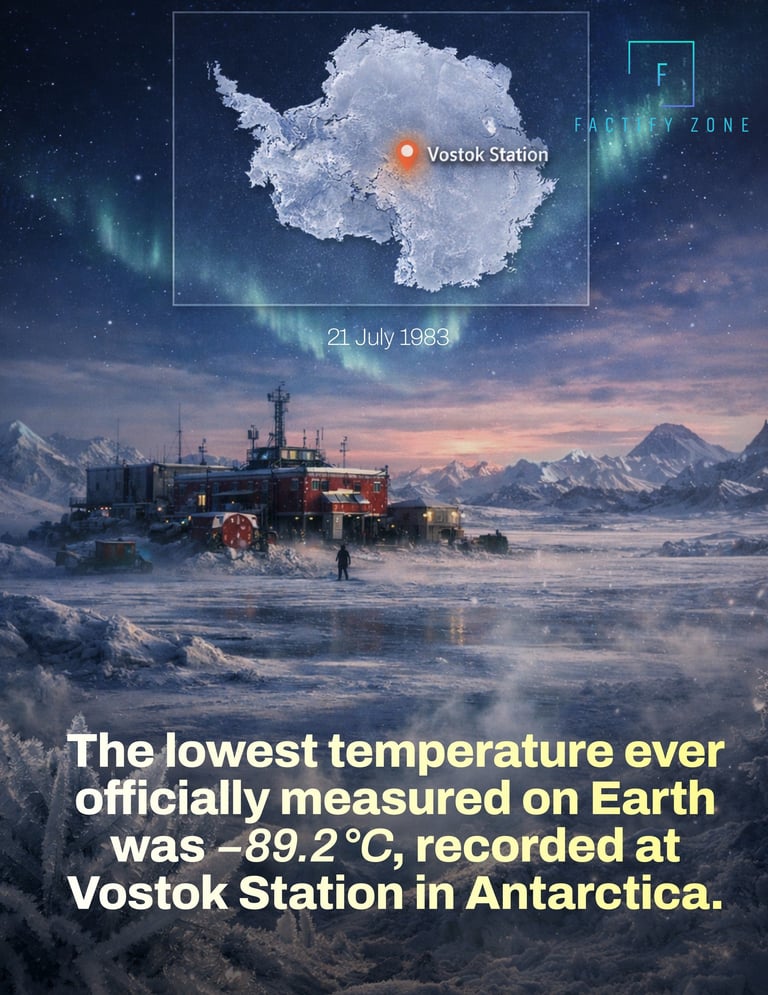
The Coldest Temperature Ever Recorded on Earth: -89.2°C at Vostok Station
On July 21, 1983, scientists at Vostok Station recorded the coldest officially measured temperature on Earth: a staggering -89.2°C (-128.6°F). More than four decades later, this record still stands, marking one of the most extreme weather events ever documented on our planet. Where Is Vostok Station? Vostok Station sits deep within the interior of Antarctica, far from the moderating influence of the ocean. Positioned atop the East Antarctic Ice Sheet at an elevation of about 3,500 meters (11,500 feet), the station is one of the most isolated research outposts in the world. Its location plays a major role in its brutal climate: High elevation leads to thinner air and colder temperatures. Distance from the coast eliminates warming ocean effects. Long polar nights prevent solar heating for months at a time. Clear skies and dry air allow heat to radiate quickly into space. Together, these factors create the perfect conditions for record-breaking cold. What Does -89.2°C Really Mean? To put this into perspective: At -40°C, exposed skin can freeze in minutes. At -60°C, metal becomes brittle and fuel can thicken. At -89.2°C, even breathing becomes dangerous without protection. At such temperatures, eyelashes freeze instantly, machinery struggles to function, and any exposed skin can suffer frostbite in seconds. It’s not just cold—it’s an environment fundamentally hostile to unprotected human life. Life and Research in Extreme Conditions Despite these extremes, scientists continue to work at Vostok Station year-round. Their research includes: Climate history reconstruction through deep ice cores Atmospheric studies to understand global weather systems Glaciology research examining the Antarctic Ice Sheet Exploration of subglacial Lake Vostok, one of the largest lakes hidden beneath miles of ice Ice core samples taken near Vostok have provided climate records going back hundreds of thousands of years, offering crucial insights into Earth’s past atmospheric conditions and long-term climate cycles. The 1983 record serves as a reminder of the physical endurance required by researchers who operate in this frozen frontier. Why Antarctica Gets So Cold Unlike the Arctic, Antarctica is a high-altitude landmass covered in thick ice. Several factors combine to create its extreme temperatures: Polar night: During winter, the Sun does not rise for months. High reflectivity: Ice reflects most incoming solar radiation. Dry atmosphere: Minimal moisture means less heat retention. Stable air masses: Cold air pools and remains trapped over the plateau. These conditions allow temperatures to plunge far below those found anywhere else on Earth. A Benchmark of Earth’s Extremes The -89.2°C record at Vostok Station stands as a benchmark for environmental extremes. While satellite measurements have detected even colder surface readings in parts of Antarctica, the 1983 measurement remains the coldest officially recorded air temperature at a ground-based weather station. More than just a number, this milestone symbolizes: The raw power of Earth’s climate systems The resilience of scientific exploration The dramatic environmental contrasts found across our planet In a world where deserts can exceed 50°C and tropical oceans stay warm year-round, Antarctica reminds us that Earth also contains places so cold they redefine the limits of survival. Final Thoughts The record set at Vostok Station is not merely a historical statistic—it’s a testament to the extraordinary conditions that exist in Earth’s most remote regions. It highlights both the severity of the Antarctic interior and the dedication of researchers who brave these conditions to expand our understanding of the planet. From blazing deserts to frozen plateaus, Earth continues to surprise us with its extremes—and Antarctica remains its coldest frontier.
FACTS ARROUND THE WORLD
2/25/20261 min read
Owl's keen gaze